
The silent sentinel of the east: How Gabriel Kwamigah-Atokple Tanko is redefining Volta’s voice on the Council of State
Feature Article
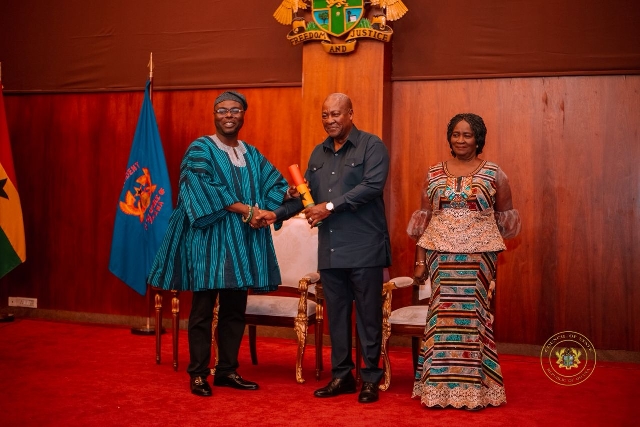 L-R (Pic): Gabriel Kwamigah-Atokple Tanko, President John Dramani Mahama, and Vice President Prof Naana Jane Opoku-Agyemang
In the architecture of Ghana’s democracy, the Council of State serves as the nation’s “conscience,” offering counsel to the president in the performance of his functions.
Established under Chapter 9 (Articles 89–92) of the 1992 Constitution, the body operates largely outside the daily glare of partisan politics, yet plays a crucial advisory role on key national appointments and constitutional matters. It comprises eminent personalities, including former high-ranking officials, presidential appointees, and elected representatives from each region.
For the Volta Region, representation on the council has historically served as a strategic bridge between grassroots concerns and the presidency at Jubilee House.
Since the inception of the Fourth Republic in 1993, the Volta Region has been represented by distinguished individuals spanning traditional authority, corporate leadership and public service. Personalities such as Togbe Kpangbatriku III, Bernard Kwasi Glover, Togbui Binah Lawluvi VI, and Francis Albert Seth Nyonyo each left distinctive imprints during their respective tenures.
In 2025, the region’s narrative entered a new chapter with the emergence of Gabriel Kwamigah-Atokple Tanko, whose election signaled what many observers describe as a generational shift in style and substance.
At 37, Tanko stands among the youngest members in the history of the Council of State. His rise challenges the long-standing perception of the council as a ceremonial enclave reserved for elder statesmen in quiet retirement. Rather than adopting a passive advisory posture, he has projected an image of active engagement positioning the Volta Region not merely as a beneficiary of state policy but as a competitive destination for investment and development partnerships.
Drawing on his background as Chief Executive Officer of Sesi-Edem Company Ltd and his experience in project management, Tanko has framed his role as that of a regional advocate and investment mobiliser. He has championed private-sector participation and Public-Private Partnerships to unlock what he describes as the region’s vast untapped resource potential. His advocacy has particularly centered on agricultural modernisation, promoting large-scale rice farming and mechanisation, inspired in part by his own farming enterprise in Ziope.
His efforts have reportedly translated into investor interest in the Weta Traditional Area of Ketu North, where plans are underway for modern rice mills and a sugar factory to revitalise long-standing rice and sugarcane production. By linking primary agriculture to agro-processing, the initiative aims to build a value chain capable of generating employment and curbing youth migration.
Beyond industrial advocacy, Tanko has supported township development and basic infrastructure, including funding for water projects and logistical support for community-based media organizations.
In the social sector, Tanko has undertaken direct philanthropic interventions through his foundation, funding medical procedures, providing stipends to vulnerable individuals, and supporting victims of coastal tidal waves in communities such as Salakope, Amutinu, and Agavedzi. Collaborating with civil society groups, he has also participated in large-scale feeding exercises across parts of Akatsi, Keta, Ketu North and Ketu South, while extending assistance to orphanages in Ho and Kpando.
Education, sports and the creative arts form another pillar of his engagement strategy.
Through initiatives such as the Ketu North Scholar programme and the establishment of academic prizes at the , Tanko has sought to institutionalize merit-based recognition. He has also backed regional sporting tournaments and lent support to creative talents, including internationally recognized Ghanaian musician , positioning culture and athletics as vehicles for youth empowerment and regional branding.
Beyond economics and philanthropy, Tanko has engaged traditional and religious leaders, urging integrity, conflict resolution and unity as prerequisites for sustainable growth. By advocating dialogue in chieftaincy matters and calling for transparency within traditional institutions, he argues that peace and moral credibility are essential to attracting investment.
As the Volta Region’s latest voice on the Council of State, Gabriel Kwamigah-Atokple Tanko appears intent on transforming what was once viewed as a quiet advisory seat into an active platform for regional transformation proving that one can be both a constitutional counselor in Accra and a hands-on development champion at home.


Trending Features

‘We cannot confuse participation with responsibility’ – Callistus Mahama
09:54
Gov't urged to respect PR professionals in major World Cup raffle campaign
05:31
Ghana’s economic turnaround: A new era for investment and partnerships
03:55
Tactical and performance analysis of the 5–1 defeat of the Ghana national football team by the Austria national football team
11:37
Restoring a national institution: The leadership blueprint behind NIB’s revival
11:27
Press freedom and reputation: Striking the balance in a democratic society
11:12
From aspiring driver to lawyer: The inspiring journey of Elikem Kwaku Ahialey
17:28
EPL Ghana commends fellows at WACSI and GCX for outstanding contributions
17:12
From tomatoes to galamsey: How Ghana’s broken agricultural policy drove farmers into the pits
01:15
