

Ghana Global leadership Awards2026: Ga Mantse, Prof Elsie Kauffman, Dr. Akwasi Agyemang, Akosua Agyapong and others honoured
News
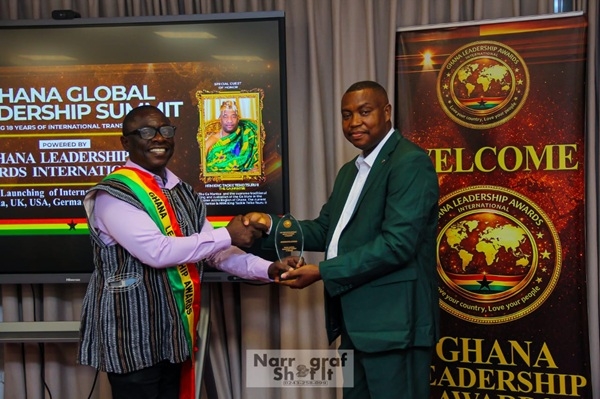 Dr Akwsi Agyemang receiving his award
Ghana Leadership Awards International (GLAI) on Friday, June 5, 2026, held its 18th Awards Event in Accra to honour distinguished Ghanaians whose visionary leadership and achievements continue to inspire future generations and contribute significantly to national and international development.
The awardees included notable personalities such as His Royal Majesty, the Ga Mantse, Nii Teiko Tsuru; Professor Elsie Kauffman, Moderator of the National Science and Maths Quiz; Dr. Akwasi Agyeman, Editor of the Adom Brands of Multimedia Group Limited; Okronkronyi Nyame Somafo Yawoh leader of the Asomdwee Ntonton Som and Akosua Agyapong, the renowned musician, entrepreneur, and philanthropist.
In his remarks, Rev. Prof. Emmanuel Yao Nash, an author and Founder/CEO of Ghana Leadership Awards International (GLAI), explained that as GLAI celebrates 18 years of God's faithfulness in 2026, the institution is proud to recognize visionary leaders whose achievements continue to inspire future generations and contribute significantly to national and international development.
Rev. Prof. Nash further noted that Ghana Leadership Awards International now enjoys strong international recognition, with a growing audience reach of over 286.47 million people globally through its leadership platforms, media engagements, policy contributions, and international partnerships.
According to him, the summit creates real leadership, diplomatic, business, investment, and networking opportunities by connecting influential leaders and institutions to a large international audience, thereby facilitating partnerships, expansion, influence, and transformation.
"Today, Ghana Leadership Awards International continues to provide a powerful platform that connects leaders, institutions, businesses, and organizations with national and international audiences, creating opportunities for influence, partnerships, and sustainable growth," he stated.
Dr. Akwasi Agyeman was selected for his meritorious service as a journalist spanning more than two decades. He was also recognized for recently earning a Doctor of Philosophy (PhD) degree in African Studies (History and Politics) from the University of Ghana. His academic achievement has inspired many journalists across the country to pursue higher education and enhance professionalism within the media fraternity.
As part of the event, Dr. Agyeman delivered a presentation on the theme, "The Role of the Media in Climate Change: The Ghanaian Media Experience."
He explained that climate change is no longer a distant environmental concern but a reality affecting livelihoods, economies, and communities across the world. In Ghana, its impacts are increasingly evident through floods, prolonged droughts, coastal erosion, rising temperatures, and unpredictable rainfall patterns.
According to Dr. Agyeman, these challenges underscore the urgent need for collective action, informed public discourse, and sustained media engagement in addressing one of the greatest threats of our time.
He emphasized that the media occupies a strategic position in the fight against climate change. As the bridge between scientific knowledge and the public, the media informs, educates, and mobilizes citizens to understand environmental issues and adopt sustainable practices.
Citing media scholar Denis McQuail (2010), Dr. Agyeman noted that through news reports, documentaries, feature stories, discussions, and social media content, journalists help translate complex climate science into information that ordinary citizens can understand and act upon.
He reminded journalists that one of the most important roles of the media is raising public awareness. Many Ghanaians first learn about climate-related issues through radio, television, newspapers, and digital platforms. Media reports on flooding in Accra, droughts in northern Ghana, illegal mining, deforestation, and coastal erosion have helped draw national attention to environmental challenges and their consequences.
Dr. Agyeman further observed that the media serves as an educational tool. Through expert interviews, environmental programmes, and public discussions, media organizations educate citizens about the causes and effects of climate change. Such education encourages individuals and communities to adopt environmentally friendly behaviours such as proper waste disposal, tree planting, water conservation, and responsible energy consumption.
He also highlighted the media's watchdog role in holding governments, industries, and other stakeholders accountable for environmental policies and practices. Investigative journalism, he said, has exposed illegal logging, pollution, and environmental degradation in several parts of Ghana, thereby promoting transparency and encouraging authorities to enforce environmental regulations.
In Ghana, radio remains one of the most effective channels for climate communication due to its extensive reach, particularly in rural communities. Community radio stations provide information in local languages, making climate messages more accessible to farmers, fisherfolk, and other vulnerable groups.
The rise of digital and social media has further expanded opportunities for climate communication. Platforms such as Facebook, X, YouTube, and WhatsApp enable journalists, environmental organizations, and citizens to share information instantly and engage in discussions on climate-related issues. These platforms have become valuable tools for environmental advocacy and public mobilization, particularly among young people.
Despite these contributions, Dr. Agyeman acknowledged that the Ghanaian media faces several challenges in reporting climate change. Climate issues are often perceived as highly technical and scientific, making them difficult for journalists to interpret accurately. Limited funding and inadequate training also restrict the ability of many media organizations to undertake specialized environmental reporting. Additionally, climate stories sometimes receive less attention than politics, sports, and entertainment, reducing their visibility on the national news agenda.
To improve climate reporting in Ghana, he called for continuous capacity building for journalists, stronger collaboration between media practitioners and climate scientists, and increased investment in environmental journalism.
He also urged media houses to dedicate more airtime and space to climate-related issues, recognizing that environmental sustainability is directly linked to national development.
Dr. Agyeman argued that the media's role in addressing climate change aligns with Development Media Theory, which holds that media in developing countries should contribute to national development by educating citizens and supporting social progress.
Climate change, he stressed, is undoubtedly one of the greatest development challenges of our time, and the media must be at the forefront of efforts to create awareness, influence policy, and inspire action.
He reiterates that the Ghanaian media has made significant contributions to climate change communication through awareness creation, public education, advocacy, and accountability. However, he emphasized that much more remains to be done.
"As journalists, communicators, policymakers, and citizens, we must work together to ensure that climate information reaches every corner of our country and inspires meaningful action toward a sustainable future," he said.
He concludes that the fight against climate change is not solely the responsibility of governments and environmental organizations but a collective duty in which the media has an indispensable role to play in leading the national conversation.
Source: Classfmonline.com/Cecil Mensah


Trending News
Ghana fish for development programme concludes after strengthening sector
15:14
C/R: 3 arrested in Winneba police raid targeting illegal mining near water main lines
01:01
Krowor MP and Gender Minister provides cash support to victims of Nungua fire disaster
21:42
National Ambulance Service pays courtesy call on NPA Chief Executive
03:39
GenCED condemns alleged remarks by Ashanti Regional Minister against Akosua Manu
21:30
Amin Adam accuses government of introducing new taxes despite abolishing ‘nuisance taxes’
02:42
15 killed, several injured in fatal Peki–Tsame road crash
17:42
Ghana marks milestone as locally produced Jubilee crude oil is delivered to Sentuo Refinery
14:35
Tamale High Court sentences man to 15 years for defilement and jail for perjury
00:57
President John Dramani Mahama has arrived in Minsk to begin a state visit to the Republic of Belarus
18:32