
Afenyo-Markin calls for bipartisan reflection on Ghana’s political history
Politics
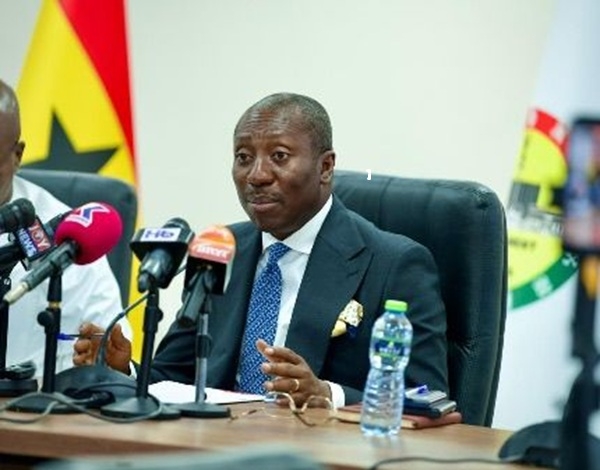 Alexander Afenyo-Markin, MP for Effutu
The Minority Leader in Parliament, Alexander Afenyo-Markin, has urged lawmakers to adopt a balanced and bipartisan approach in reflecting on Ghana’s political history, stressing the need to recognise the contributions of past administrations regardless of party affiliation.
His comments were made during a debate on a statement by the Minister for Lands and Natural Resources concerning the overthrow of Kwame Nkrumah, Ghana’s first President.
Contributing to discussions on the floor of the Parliament of Ghana, Mr Afenyo-Markin highlighted what he described as the significant industrialisation drive under Nkrumah’s leadership.
He noted that the founding President laid a strong foundation for state-led industrial growth through the establishment of factories and key infrastructure aimed at building a self-reliant economy.
While acknowledging the historical controversies surrounding the 1966 coup, the Minority Leader emphasised the importance of separating political disagreements from national development achievements.
He argued that Ghana’s progress has been cumulative, shaped by successive governments that have each contributed uniquely to the country’s development.
He cited decentralisation initiatives introduced during the Second Republic and the expansion of private sector participation over the years as part of the country’s evolving governance and economic reforms.
Mr Afenyo-Markin also credited the administration of former President John Agyekum Kufuor for policies such as the “Golden Age of Business,” the introduction of the National Health Insurance Scheme (NHIS), and social intervention programmes that later influenced the Free Senior High School (Free SHS) policy.
According to him, Ghana’s political discourse must move beyond partisan narratives that either glorify or diminish past leaders.
Instead, he advocated an objective national approach that studies both the successes and shortcomings of policies to inform future development.
“Our history must not be reduced to political point-scoring.
We must recognise what worked, learn from it, and build upon it for the benefit of future generations,” he stated.
The debate on Nkrumah’s overthrow has reignited discussions about governance, democracy and Ghana’s development trajectory since independence.
While some Members of Parliament focused on the political implications of the coup, Afenyo-Markin’s intervention redirected attention to policy legacies and nation-building outcomes.
Observers say his remarks reflect a broader appeal for national unity and institutional continuity, underscoring the view that Ghana’s development is a shared and evolving project rather than the preserve of any single political tradition.


Trending News

Gender Minister supervises safe discharge of rescued baby, settles bills and engages police on probe
07:18
Former student speaks about misconducts at Royal Nursing Training College
12:51
Minority raises alarm over delayed rent allowances to Ghana Prisons Service officers
19:10
33-year-old woman remanded over Mamprobi Polyclinic baby theft
22:24
Works and Housing Minister assures public of action on water crisis
02:24
CDAG demands NPA revoke licenses of OMCs selling contaminated fuel
12:35
GH¢23bn cocoa road contracts deepened COCOBOD’s crisis -Roads Minister
17:56
NSA Board Chairman engages TEIN leadership at UNIMAC
14:11
'Ghana’s industrial comeback is underway': President Mahama unveils $250m float glass factory in Shama
01:02
OSP probes alleged diversion of palm oil consignment meant for Burkina Faso
13:32