

US-Iran talks postponed as Vance pulls out of Switzerland trip
World News
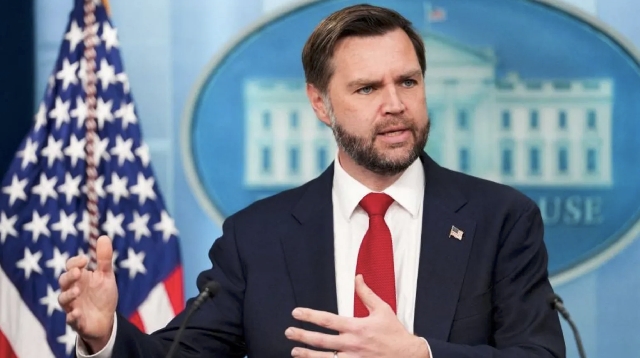 Reuters (Pic): US Vice-President JD Vance cancelled his planned trip to Switzerland late on Thursday
A new round of direct talks between the US and Iran have been postponed after Vice-President JD Vance delayed a planned trip to Switzerland.
The White House announced late on Thursday that Vance would not be travelling to the talks and said the logistics had not been "simple or predictable".
It comes a day after the US dropped its naval blockade of Iran after the two countries signed a deal aimed at ending the conflict.
While the deal also said fighting should end in Lebanon, the country's health ministry said Israeli strikes had killed at least 18 people in the south overnight.
Israel's military said it had targeted the Iran-backed group Hezbollah, and that four of its own soldiers had been killed.
Hours before the White House issued its statement, Hezbollah-linked Lebanese media reported that the talks had been suspended due to ongoing Israeli air strikes.
Negotiators had been due to meet for what US officials described as "technical discussions" on the next steps of the agreement signed earlier this week.
But Washington said plans for the talks had "not been finalised". It added that the US looked forward to "beginning technical talks as soon as possible".
Switzerland's foreign ministry later confirmed the talks at the Burgenstock mountaintop resort had been "postponed", although it said preparations for talks were continuing.
Swiss military and police officials had been patrolling the luxury hotel set high on a mountain overlooking Lake Lucerne, and a media centre had been set up for journalists.
The negotiations had been expected to focus on implementing the agreement, which is known as a Memorandum of Understanding, and begin discussions on longer-term issues, including Iran's nuclear programme.
Centred around 14 points, the deal includes reopening the Strait of Hormuz, a requirement that Iran will never have a nuclear weapon, a $300bn (£224bn) plan for Iran's "reconstruction", and the US terminating "all types of sanctions" on Iran.
It also binds both sides to achieving a final deal in a "maximum" of 60 days, which could be extended with mutual consent.
Iran's Supreme Leader Mojtaba Khamenei said he had approved the deal with the US despite having a "different view", claiming Trump had "out of desperation, used all kinds of leverage" to bring it about.
He said that while there would be "in-person negotiations in the future" between Tehran and Washington, this would "not mean acceptance of the enemy's position".
President Trump has said he expected a ceasefire to take effect "on all fronts", including between Israel and Hezbollah in Lebanon, something which is also set out in the text of the agreement.
But both Israel and Hezbollah have carried out strikes against each other since the deal was announced.
Lebanon's state news agency described the overnight bombardment as one of the most intense of the war, with the health ministry reporting at least 18 killed, 33 injured and several buildings hit.
The Israel Defense Forces (IDF) said it had targeted infrastructure and individuals linked to Hezbollah.
Responding to the deaths of the four IDF soldiers on Friday, Israel's far-right National Security Minister Itamar Ben-Gvir said that "all of Lebanon must burn".
"With all due respect to the Americans, Israel must make it clear to the entire world that the blood of our sons and the security of our citizens are not up for bargaining," he wrote on X.
Vance had publicly criticised the attitude of some members of Israeli Prime Minister Benjamin Netanyahu's cabinet towards the deal on Thursday, including Ben-Gvir - telling reporters Israel should "wake up and smell the reality".
Lebanon was drawn into the war between Israel, the US and Iran shortly after it began, with Hezbollah launching rockets into Israel in retaliation for a strike that killed Iran's supreme leader.
Israel responded by launching a bombing campaign across Lebanon and invading a significant part of the country's south, with the aim of driving back Hezbollah fighters from its northern border.
Since then, Lebanese health authorities say more than 3,900 people have been killed in Israeli attacks, among them women and children. It is not clear whether or how many Hezbollah fighters are among them.
Israeli authorities say at least 30 soldiers and four civilians have been killed on both sides of the border in the same period.
Source: bbc.com


Trending World
Tehran selling deal with US as victory – but for Iranians it was necessity
00:31
Somaliland opens Jerusalem embassy after Israel's recognition of its independence
00:27
Nigerian army frees widow of ex-general who died in captivity
00:23
Trump warns U.S.-Iran framework agreement is not final, threatens to resume bombing
15:50
Israel launches fresh strikes on Lebanon despite Trump criticism
15:28
Group planned to attack White House UFC event using snipers and drones, FBI says
15:26
Norway's crown princess undergoes successful lung transplant, palace says
15:23
Equatorial Guinea government resigns after failing to meet targets
15:19
Search for six-year-old Ebola patient after armed men storm DR Congo hospital
15:17
'They came with machetes' - deadline looms for migrants to leave South Africa
15:12
