

Norway is building the world’s longest, deepest undersea road tunnel
World News
 World's longest and deepest undersea road tunnel being built in Norway
The world’s longest and deepest undersea road tunnel is being built in Norway, intended to cut travel time between major cities and become part of a ferry-free highway along its western coast.
The 27-kilometer (17-mile) long tunnel is called Rogfast — short for “Rogaland fastforbindelse,” after the name of the region it’s in and the Norwegian word for “fixed link.” At its deepest it will be 392 meters (1,286 feet) below sea level.
Construction started in January 2018 but was halted in late 2019 due to predicted cost overruns that led to the cancellation of existing contracts and a restructuring of the project. Work resumed in late 2021 and the tunnel is now slated for completion in 2033, at a cost of approximately 25 billion Norwegian kroner (about $2.4 billion).
“The tunnel will significantly improve connectivity along the Norwegian west coast, by creating a faster and more reliable link between the Stavanger and Haugesund regions,” said Anne Brit Moen, a project manager at Skanska, the multinational construction company that’s building the northern part of the tunnel, which is the deepest section and is 9 kilometers (5.5 miles) long.
By replacing the current ferry connections, Rogfast will reduce travel time between Bergen and Stavanger — respectively the second and fourth largest Norwegian cities by population — by around 40 minutes and make daily commuting much easier, Moen added.
The tunnel will consist of two separate tubes, each with two traffic lanes, designed exclusively for road traffic, and will sport a rather unusual design element roughly halfway through: a double roundabout, 260 meters deep, linking out to a connection tunnel leading to the island of Kvitsøy, Norway’s smallest municipality.
High-tech measurements
Building a tunnel of that length under the sea poses several technological challenges. Like most modern tunnels, to save time, Rogfast is being built from both ends concurrently, with the goal of having the two construction teams meet in the middle within a margin of error of just 5 centimeters (1.97 inches).
Achieving this level of precision requires careful measurements using lasers and other sophisticated equipment. A spinning, mirrored laser scanner measures a newly excavated tunnel portion, collecting 2 million data points per second to create a “digital twin” of the tunnel. That can then to be checked against the design plans for any inaccuracies.
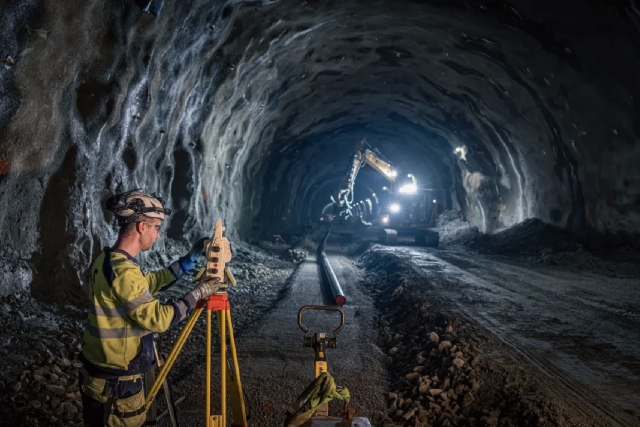 | Skanska (Pic): Laser measurement equipment is used to ensure the two ends meet in the middle accurately
“It’s a little bit away from the romantic view of the of the surveyor looking through an eyepiece,” said Burkhard Boeckem, chief technology officer at Hexagon, the company that is providing the measurements for the tunnel.
The 5-centimeter (1.9-inch) margin is among the strictest in the world, but can save time, money, waste, and emissions by avoiding mistakes: “If you deviate from this, you create so much more material that needs to be taken out, and then so much more to be filled in again — it’s a lot of whole trucks. So, it’s not just a risk factor, but also a very financial factor.”
Technically demanding
The Rogfast project is part of a revamp of the E39 coastal highway, a 1,100 kilometer (684-mile) road that runs from Trondheim in the north to Kristiansand in the south. Today it takes 21 hours to drive the entire length of the road, which includes seven ferries. The goal is to make it ferry-free by building tunnels and bridges, cutting travel time in half. Completion is not expected before 2050.
Rogfast is one of the most ambitious and technically demanding components of that plan, and construction hasn’t been hurdle-free, according to Moen. “The main challenge so far has been to find good enough grouting methods to seal the rock,” she explained. “We are now 300 meters (984 feet) below sea level, and we have already had quite extensive saltwater leaks in the tunnel system. Since we are going all the way down to 392 meters (1,286 feet) below sea level, we’re focusing on finding the best methods to maintain safe and efficient working conditions for everyone.”
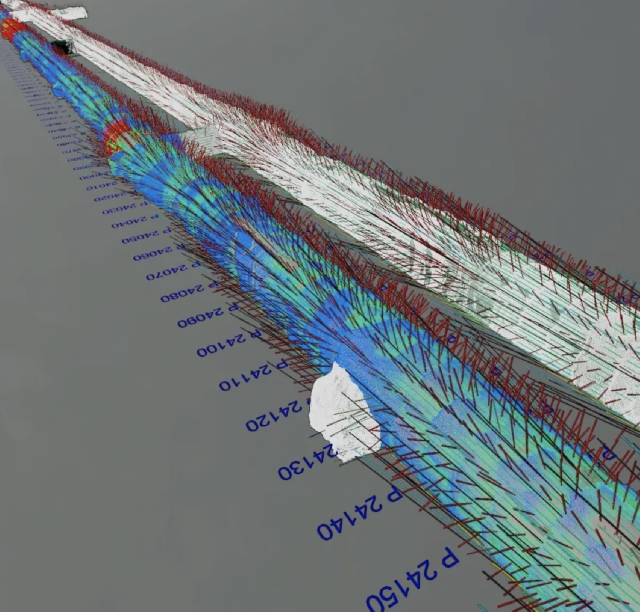 | Skanska (Pic): Measurement While Drilling" data is used to analyze and visualize the geological conditions along the tunnel
The tunnel also requires measures to protect motorists from air pollution. It will employ a longitudinal ventilation system — which typically use jet fans to create airflow — complemented by shaft ventilation extending up to Kvitsøy. “This combination is designed to ensure effective air circulation and safety throughout the tunnel’s considerable length,” said Moen.
A real-time incident alert will also be implemented to identify events such as breakdowns or congestion, and cameras and radar will monitor vehicles.
Although jobs would be eventually lost from ferry closures, Rogfast will strengthen access to other jobs, education, and public services for local communities, Moen said, and have positive effects on the local economy and the seafood industry, as logistics costs will go down and companies will be able to operate across a wider area. “The project also creates substantial employment during construction and lays the groundwork for more sustainable and integrated regional development along Norway’s fractured western coastline,” she said.
 | Skanska (Pic): This illustration shows Rogfast’s dual-tube configuration, with a central emergency passage. The design includes cross connections, pedestrian escape routes, and safety installations for efficient traffic flow and emergency access
Currently, the title of world’s longest tunnel with an undersea section belongs to the Seikan Tunnel in Northern Japan, a railway-only tunnel that has a total length of 53.85 kilometers (33.5 miles), with an undersea section spanning 23.3 kilometers (14.5 miles).
The Channel Tunnel, which is also railway-only and connects England to France, is shorter, at 50.46 kilometers (31.35 miles), but its 37.9 km (23.5-mile) undersea section is longer than Rogfast. Rogfast, however, will be much deeper below sea level than either Seikan or the Channel Tunnel, which bottom out respectively at 240 meters (790 feet), and 115 meters (377 feet).
Source: cnn.com


Trending World

Guinea-Bissau president flees to Senegal after coup
10:42
Japan's same-sex marriage ban is constitutional, says Tokyo court
10:40
The kidnap gangs, jihadists and separatists wreaking havoc in Nigeria
10:38
Trump says US will 'permanently pause' migration from 'third world countries'
10:32
Relocation of Ukrainian children is humanitarian, not abduction- Russian Ambassador
09:18
Nigeria blames jihadist groups for wave of kidnappings but others accuse criminal gangs
00:44
Pope Leo visits Istanbul's Blue Mosque
00:37
Nigerian villagers 'too scared to speak' after hundreds of schoolchildren kidnapped
15:45
Australian prime minister becomes first to wed in office
14:55
Benjamin Netanyahu seeks pardon from Israel's president
14:47