
UG Vice Chancellor leads global push for better representation of African languages in AI revolution
Education
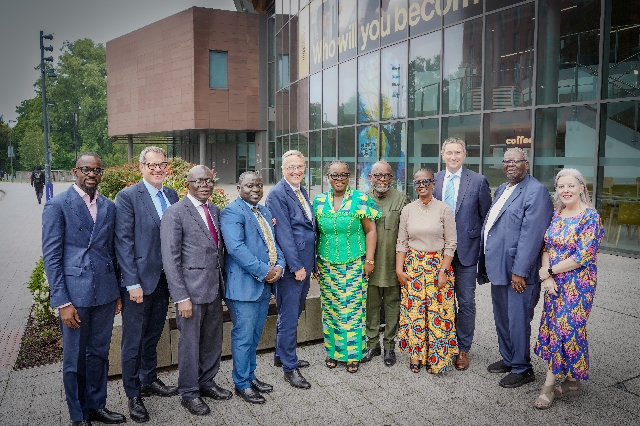 Professor Nana Aba Appiah Amfo (centrę in green)
Delivering the Warwick Distinguished Africa Lecture in the UK, Professor Nana Aba Appiah Amfo, argued that Africa's diverse language basket is not a barrier to technological progress but an intellectual infrastructure the world cannot afford to ignore.
Vice Chancellor of the University of Ghana, Professor Nana Aba Appiah Amfo has warned that world is at a risk of missing out on Africa’s rich cultural representation without a clear and intentional inclusion of African languages in the global artificial intelligence revolution. She said this while delivering the Fifth Warwick Distinguished Africa Lecture at the University of Warwick in the United Kingdom on Thursday, June 11, 2026.
Her lecture, titled: “Whose Language Counts? African Voices, Knowledge Systems, and the Future of AI,” made the case that without embedding African languages in the design of Artificial Intelligence, the systems being built to serve the world will serve only part of it.
Despite the continent’s over 2000 living languages spoken by its more than 1.4 billion people, a recent UNESCO report described African languages as a “blind spot in AI”. Professor Appiah Amfo, who is also the Chairperson of the Association of Commonwealth Universities, said this is not because they lack complexity, but because they remain dramatically underrepresented in the database on which large language models are trained.
She argued that: “When a language is absent from the digital corpus, it is not merely a translation problem. It is a visibility problem. It is a knowledge problem. And ultimately, it becomes a question of justice.”
According to her, the problem is deeper than linguistics. She insisted that when AI is trained mainly on English and other dominant languages, it creates an inequitable system where Western knowledge frameworks are passed on as universal while African philosophical traditions, oral knowledge systems, and indigenous nuances remain unseen.
At the University of Ghana for instance, a group of students building the “Nana Aba AI”, an innovative voice assistant modelled on the Vice-Chancellor herself to help students and staff with verified information on different parts of university life.
But after encountering it, she noted: “The system could reproduce 'me' in English with considerable success. The moment it encountered Ghanaian names, places, and phrases, the voice I was hearing no longer sounded like me. My own name did not sound like mine. I have now been tasked to record my voice in a studio so the system could learn what I actually sound like when I speak Ghanaian languages or mention Ghanaian names. That is a precise illustration of what is wrong. AI does not struggle with African languages because they are too complex. It struggles because we have not yet been seen.
“So, the question is not whether Africa will participate in AI. Africa is already participating. The question is: will Africa participate merely as a consumer of externally developed systems, or will Africa help shape the languages, values, assumptions, and knowledge structures embedded within those systems?”
The lecture follows the recent launch of Ghana's National AI Strategy which aims to position the country as a leader in continental efforts towards safeguarding Africa’s future. The 10-year strategy is backed by a $250m government commitment, which will among other things, fund the establishment of a world-class artificial intelligence computing centre, to develop and improve the natural language processing capabilities in Ghanaian languages.
With the University of Ghana developing and adopting its own AI Policy earlier this year, Professor Appiah Amfo said the university will roll out a compulsory Digital Literacy and Applied AI course for all students from the next academic year, to prepare them to confidently use AI in the future.
Warwick’s ViceChancellor and President, Professor Stuart Croft, said: “It was a pleasure to welcome Professor Amfo to Warwick for this year’s Distinguished Africa Lecture. Her contribution highlights the importance of diverse perspectives in shaping the future of research and innovation. Our growing relationship with the University of Ghana reflects a shared commitment to collaboration that is thoughtful, mutually beneficial and grounded in areas of common interest.”
Professor Nana Aba Appiah is the second Ghanaian to deliver the lecture since it started 5 years ago, following in the stead of former University of Ghana Vice Chancellor, Emeritus Professor Ernest Aryeetey.
Source: classfmonline.com


Trending News
UG Vice Chancellor leads global push for better representation of African languages in AI revolution
02:15
NAiMOS presents seized firearms to Interior Ministry for processing and destruction
07:06
Zoomlion, NADMO, FeDEMS, DML & partners begin 3 day anti-flood clean in Accra
10:26
Minority demands Foreign Affairs Minister brief Parliament on Ghana-South Africa diplomatic standoff
15:43
Mahama orders comprehensive flood assessment as Accra battles rising flood risk
18:10
Osenase Queenmother declares stool vacant, rejects Okyenhene’s claimant
02:05
GA/R: 2026 Apostolic Visitation commences at Cedar Mountain Chapel
19:34
Afari Military Hospital 60% complete as Gov't moves to revive stalled project - Deputy Defence Minister
07:03
Accra Flood: Seized galamsey excavators to be deployed for nationwide drainage works – Muntaka
08:53
World Environment Day: Volta Environmental Health Officer advocates responsible waste management to protect future generations
15:40
