

Morocco’s struggle to crunch the numbers: AFCON 2025
Sports News
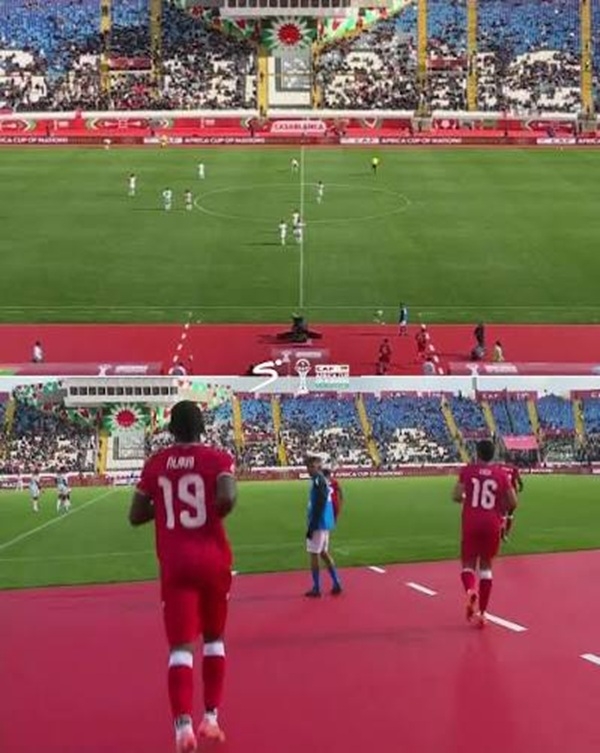 Morocco's empty stadia
"I don’t feel the same vibe I felt in Ivory Coast or Gabon, where every second of the tournament you felt like you were truly in a tournament.
There is no vibe here; there is no typical AFCON atmosphere.
It’s fine that we play the games and have the stadiums and everything we need, but in Ivory Coast, the stadiums were full and the crowds were involved.
When we took the bus to training, people were waving and carrying flags. Here, you see nothing.” These are the tough but reflective comments of South African Coach Hugo Broos,
I have been in Morocco the last 5 days and to be honest, this could not have been captured any better.
I am based in the country’s commercial capital of Casablanca, which has a population of 4 million people.
For a city that plays host to two of the most dominant football clubs on the continent in Raja and Wydad Casablanca and buzzing with a lot of sporting action, one would have thought that for a competition which has not been here in 37 years (Morocco last hosted in 1988) and for a country that would be hosting the World Cup in 5 years, the fan interest would be on another level.
Far from that. It’s been dry.
The locals do not appear to be overly excited about this and have given a myriad of reasons.
ECONOMIC
Weeks before the start of the competition, there were huge demonstrations by the Moroccan Gen Z’s who were not amused by the country’s huge expenditure on sporting infrastructure at the expense of what they thought was more pressing with respect to areas like Education, Health, Youth Unemployment and provision of portable water. There were massive demonstrations in many cities, including Casablanca (where I am based).
For Yahya, a local in Anfa (a neighbourhood in Casablanca) and his friends, they simply can’t be bothered. They have more pressing issues to worry about. Bread and butter issues of course.
The organisers have gone out of their way to issue out a number of tickets to augment the fan base but to little or no avail. I was at the game between Comoros and Zambia a few days ago and they were just a little under 8000 fans at the Mohammed V Stadium. For a stadium that hosts up to 45,000 fans, this was less than a 5th of the capacity. It was not any different from an earlier game involving Burkina Faso and Equatorial Guinea at the same Venue. Despite the large number of Burkinabes resident here, the numbers were not impressive.
I have to admit though that the numbers at some of the venues have been great. I was at the game between Senegal and DR Congo at the Stade Ibn Batouta in Tangier and it was literally taken over by the fans of the two countries with very little support from the locals. Up to 41,672 were there for the game. The organisers would have to do more by possibly offering as many free tickets to get the fans fill up the stadiums and create a fan atmosphere.
TICKET RE-SALE
I met a young man, Mohammed, who lives within the precincts of the Mohammed V stadium trying hard to convince me to buy his ticket for the Burkina Faso-Equatorial Guinea game. When he found out that I was an accredited journalist and didn’t need a ticket, the disappointment was clear.
He would later confide in me in his “broken” English that he knew a number of friends who bought the tickets when they went on sale ostensibly to sell to fans at higher prices when the competition started but with the fans failing to show up both locally and from outside, they had to sell them at a giveaway process to recover their investments. And that appears to be a struggle as many who wanted the tickets and couldn’t get them on line have moved on to other things.
COST OF TRAVEL/ACCOMMODATION
One of the biggest challenges in our part of the world is the cost of travel.
It is relatively cheaper to travel to other parts of the world than to travel within the continent.
To put this in context, for a distance of a little over 4 hours from Accra to Casablanca, Air Maroc was charging a whooping $1500. Yes, you read right. I wonder how much others from other parts of the continent would have to pay to get here.
Now that is only the first part. The various match venues are quite a distant from the host cities.
That means additional cost of travel on touchdown, not to talk the cost from Airport to the stadium, which averages 40minutes. For a continent where over half of its inhabitants live beyond the poverty line, these figures ae completely out of their reach even if they desperately want to travel to see the games. Alternative means like rail, water and road are barely nonexistent. Cost of accommodation is not any cheaper either. One could get a place in Abidjan for as little as $20 a night. In Morocco, it is impossible.
PROXIMITY
This massively benefited the Ivorians in the last edition. As many countries within touching distance qualified for the competition. Ghana, Burkina Faso, Nigeria, Senegal, Guinea, Mali, Cameroon, Mauritania, Gambia, Cape Verde, Equatorial Guinea and more were all there, making it relatively easier for fans to come and enjoy the games.
Thousands of Ghanaian fans came by road to see the games and go back home game by game. Same as others. Morocco is clearly distance. They only share a border with Algeria to the East. That’s it.
CITY BASED GROUPS
In previous competitions, CAF literally run on City based goups where teams played all their matches at one venue with the final group matches the only exceptions. What that meant was that as many as four set of fans go to a venue and enjoy two games back-to-back. Here in Morocco, the games are scattered all over the country making it almost impossible to see more than a game per day. With all that hustle to go see just a game, motivation is simply not there for some.
COMMUNITIES
Major Ivorian cities like Abidjan, San Pedro, Yamoussoukro, Bouake and Korhogo have huge communities of other West African nationals and more residing there and were easily able to mobilise fans on matchdays. Since I have been here, the foreigners are primarily Senegalese and Burkinabes, with trickles of others. That makes mobilisation beyond these communities a non-starter.
DOCUMENTATION
It is fair to require documentation to enter any state on the planet; when the requirements are that rigid, it makes entry for the average fan quite tough.
The Moroccans insisted on a FAN ID for fans and even accredited journalists.
The FAN ID is slow and almost impossible to sort out.
I am yet to meet any journalist who has been successful with the FAN ID. The fans also suffered the same fate and since these were requirements beyond the VISA, fans who had had enough of the online process just gave up. Some of the locals can’t even access the FAN ID, which appears to take forever after applying.
A visa was simply not enough. Here we are with the empty stadia.
I am sure the Moroccans will review all of these and more when the competition is over to improve going forward.
The FIFA World Cup and the World Cup are not too far away. They surely need to improve to give a fan appeal to the tournament. For now, though, it is simply flat with little energy at the stadium.
-Kwame Dwomoh-Agyemang is a broadcaster with the Class Media Group in Accra.
Source: Classfmonline.com


Trending Sports

FIFA WC 2026: Add Kwesi Appiah to Black Stars technical team to bolster push - Veteran journalist Owusu Bempah
22:38
FIFA names 23 Ghanaian referees for 2026 international season
20:23
Road crash: 2 killed as Anthony Joshua escapes with minor injuries in Ogun State, Nigeria
19:19
Morocco’s struggle to crunch the numbers: AFCON 2025
10:42
Bournemouth: Coach Iraola hopes to keep Semenyo amid Manchester City transfer links
12:53
George Boateng reflects on Black Stars stint, calls service to Ghana an honour
12:43
3 Ghanaians secure key roles on newly constituted WAFU Zone B committees
12:37
Kurt Simeon-Okraku: GFA President chairs FIFA’s maiden Anti-Racism and Anti-Discrimination Committee meeting
18:52
GFA President Kurt Okraku extends Christmas message of unity, hope
13:42
New WBA Africa Champion Jonathan "Worldwide" Tetteh presents title belt to Ga Mantse
09:36