

Agric Minister unveils cold storage facility and cuts sod for poultry processing complex at Kpone
Business
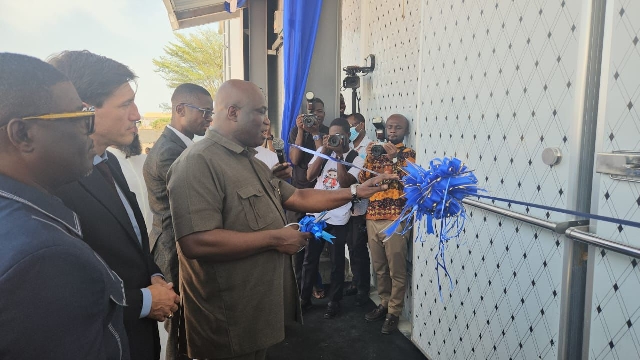 Agric Minister unveiling the cold store facility
The Minister for Food and Agriculture. Eric Opoku, on Thursday, steered the groundbreaking ceremony of Beacon Source and Services Limited’s Poultry Value Chain Project at Kpone near Tema in the Greater Accra Region.
He described the investment as a major boost to Ghana’s food security and poultry industry.
The event brought together the German Ambassador to Ghana, ministers, representatives of the German Chamber of Commerce, the Managing Director of Bostex Trading GmbH, as well as the board and management of Beacon Source and Services Ltd.
The ceremony saw the opening of an expanded cold storage facility and the sod-cutting for a poultry value addition and processing complex.
Addressing the gathering, the Minister said the facilities represent more than physical infrastructure, describing them as “strategic investments in Ghana’s food security architecture” and a strong vote of confidence in the country’s poultry sector.
He noted that the project aligns with the Government’s flagship Feed Ghana Programme, which seeks to transform the country’s agriculture and food systems.
Under the programme, livestock development—particularly poultry—has been identified as a key area for import substitution, job creation and agro-industrial growth.
According to the Minister, Ghana currently spends between US$300 million and US$400 million annually on poultry imports, a situation he described as unsustainable.
“The time has come to rebuild domestic capacity across the entire poultry value chain — from hatchery to feed production, from farm to processing, and from cold storage to market,” he stated.
He explained that under the Poultry Industry Revitalisation sub-programme of Feed Ghana, the government is tackling structural challenges in the sector, including high feed costs, weak value-chain coordination, limited access to quality day-old chicks, inadequate veterinary services and insufficient processing and cold chain infrastructure.
The Minister outlined a three-pronged strategy: supporting large-scale commercial farms under a Poultry-Farm-to-Table model; strengthening small and medium-scale producers to enhance productivity; and expanding household and community-level production through the 'Nkoko Nketenkete' Backyard Poultry Programme, with a focus on women, youth and vulnerable households.
He emphasised that increased production must be matched with adequate processing and storage capacity to avoid new bottlenecks.
“The expanded cold storage facility enhances our capacity to preserve quality, reduce post-harvest losses, stabilise supply and ensure food safety standards,” he said, adding that the processing plant will provide the industrial backbone needed to convert domestic poultry into market-ready products.
The Minister commended Beacon Source and Services Ltd. for aligning its private investment strategy with national policy objectives, describing the move into cold chain infrastructure and poultry processing as both good business and strategic nation-building.
He also praised the partnership with Germany-based Bostex Trading GmbH, saying it would facilitate technology transfer, adherence to international standards and improved competitiveness.
The Minister expressed appreciation to the German Ambassador and the German business community for their continued support for Ghana’s agro-industrial transformation, noting that such partnerships are vital to building local capacity and integrating Ghana into regional and global markets.
He called on financial institutions, development partners and private investors to support similar initiatives nationwide, stressing that revitalising Ghana’s poultry sector requires infrastructure, capital, technology and sustained public-private collaboration.
The project, he said, stands as a model of how coordinated government policy and private investment can strengthen Ghana’s poultry industry, enhance food security, create jobs and reduce dependence on imports.
Source: Classfmonline.com/Cecil Mensah


Trending Business

Samantha Cohen CVO OBE Leads Landmark Ghana Visit
13:23
GRA dismisses fears over new VAT regime, says reform will reduce prices and ease business costs
06:35
Pwalugu Tomato Factory reopening: Mahama supplies farmers with high-yield seeds, targets job creation and reduced post-harvest losses
03:07
PPPs key to meeting Ghana’s infrastructure goals in 2026 - EM Advisory
14:31
Cedi stability faces test as external risks mount in 2026 - EM Advisory
14:23
C/R: Chiefs back government’s palm nut drive to boost jobs and development
17:25
Maiden AGROTECH Fair 2026 to showcase Ghana’s agricultural technology and drive agro-industrial growth
13:25
ATM use drops sharply as mobile money dominates banking in Ghana
08:51
GIPC CEO Visits Kane-EM Industries to strengthen support for local manufacturing
03:42
NEIP, Venture Capital eyes dedicated 'Adwumawura' fund for beneficiaries
03:36