
EU, Germany and Denmark support regional dialogue on security governance in West Africa
Business
 GIZ (Pic):
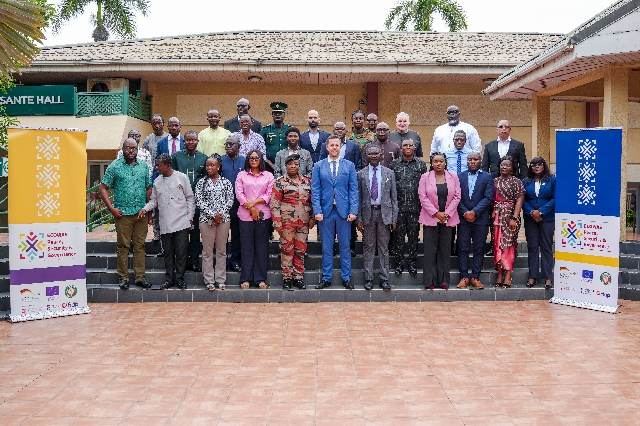
The European Union (EU), Germany and Denmark are reinforcing their cooperation in promoting peace, security and democratic governance in West Africa through a two-day stakeholder workshop in Accra, Ghana.
Organised by the Deutsche Gesellschaft für Internationale Zusammenarbeit (GIZ) GmbH and the West Africa Network for Peacebuilding (WANEP), the workshop brought together representatives of government institutions, security agencies, civil society organisations, oversight bodies and regional stakeholders to strengthen democratic governance, accountability and citizen-centered security delivery in Ghana and across the wider West African region.
The workshop aimed to support the identification of Ghana’s priority needs in Security Sector Reform and Governance and facilitated the development of a national SSRG intervention roadmap. It also strengthened stakeholder knowledge and capacity, promoted dialogue among state and non-state actors, and enhanced oversight and accountability mechanisms within the security sector, particularly through the participation of civil society organizations (CSOs).
West Africa continues to face evolving and interconnected security challenges, including violent extremism, communal violence, maritime piracy, election-related violence, farmer-herder conflicts, cybercrime, and climate-related insecurity. These transnational threats require coordinated regional responses, stronger democratic institutions and stronger more accountable security governance systems.
Security Sector Reform and Governance (SSRG) is increasingly recognized as a critical component of conflict prevention, peacebuilding, democratic consolidation and sustainable development. While Ghana has made significant progress in professionalising its security institutions, decentralising security structures and contributing to international peacekeeping operations, important challenges remain. These include concerns related to oversight and accountability, public trust, resource constraints, human rights protection and emerging security threats such as illegal mining and violent extremism.
Speaking at the opening of the workshop, EU Representative, Mr Jonas Claes noted that the engagement served as “a platform for developing a shared understanding of SSRG priorities in Ghana, assessing existing needs, strengthening stakeholder capacities, and supporting the development of practical and inclusive approaches to security governance.”
Dr George Amoh representing the National Peace Council also emphasized the importance of broad stakeholder participation in strengthening cooperation between security institutions and citizens, particularly through the involvement of civil society organizations and human rights institutions in SSRG processes.
The EU Support to ECOWAS in Peace, Security and Governance (EPSG) project is co-funded by the European Union, Germany, and Denmark. Through this partnership, the donors are supporting ECOWAS and its Member States to strengthen regional capacities for conflict prevention, democratic governance, human rights promotion and sustainable peacebuilding. This support includes interventions aimed at furthering the implementation of the ECOWAS Security Sector Reform and Governance (SSRG) Policy Framework and its Implementation Plan.
Participants in the workshop included representatives of the Police, Military, Immigration Service and other security agencies, as well as Parliament, the Judiciary, the Ministries of Defence and Interior, the National Security Council Secretariat, the Commission on Human Rights and Administrative Justice (CHRAJ), the National Peace Council (NPC), the National Commission for Civic Education (NCCE), civil society organizations and regional partners.
About EPSG
The EU Support to ECOWAS in Peace, Security, and Governance (EPSG) project supports ECOWAS in addressing security and governance challenges in West Africa by enhancing early conflict detection, security sector reform, electoral support, and inclusive peace processes. Through these efforts, the project contributes to a more stable, democratic and resilient region. EPSG is commissioned by Germany and co-financed the European Union (EU) and the Ministry of Foreign Affairs of Denmark. The project is implemented in a Team Europe Approach by the Deutsche Gesellschaft für Internationale Zusammenarbeit (GIZ) GmbH in cooperation with Expertise France (EF) and Fundación para la Internacionalización de las Administraciones Públicas (FIAP) in partnership with ECOWAS.
About GIZ Ghana
GIZ has over 50 years of experience in a wide variety of areas, including economic development and employment, energy and the environment, and peace and security. We work with businesses, civil society actors, and research institutions, fostering successful interaction between development policy and other policy fields and areas of activity. The German Federal Ministry for Economic Cooperation and Development (BMZ) is our main commissioning party. Currently, GIZ promotes sustainable development in Ghana via about 40 programmes and projects. Our activities cover three priority areas: energy and climate; sustainable economic development training and employment and peaceful and inclusive societies. Additionally, our portfolio extends to other areas such as pharmaceutical, health and agriculture. Another focus of GIZ’s work is linking business interests with development policy goals. Together with our partners, we create sustainable solutions that make a difference for Ghana, Germany and Europe. For more information, visit www.giz.de/ghana.
Source: classfmonline.com


Trending Business
Ghana to host 5th ECOWAS Trade and Industry Ministers Meeting
00:02
Uber marks 10 years in Ghana, creating economic opportunities for more than 200,000 driver-partners
14:43
GRA to launch “Tax Connect” radio programme to engage public
09:26
Ghana targets investment-grade credit rating within three years- Ato Forson
23:33
GRA engages business associations on rollout of Integrated Tax Administration System
16:52
TOR board inspects ongoing projects as refinery advances expansion and rebranding agenda
12:53
Ghana begins local refining of Jubilee crude as Sentuo Oil Refinery receives first delivery
10:49
Ghana- Caribbean week ends at Alisa Hotel with call for deeper diaspora ties
01:59
EU, Germany and Denmark support regional dialogue on security governance in West Africa
23:11
Toronto to host 2026 Ghana-Canada Investment Forum ahead of Black Stars' World Cup opener
01:04