
Mahama cautions Africa on digital health blackmail, biased AI and fake doctors
News
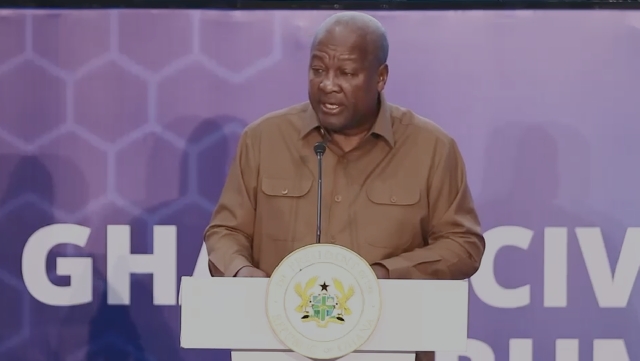 John Dramani Mahama, President of the Republic of Ghana
President John Dramani Mahama has charged African medical regulators to strengthen cooperation to protect patients during humanitarian crises, manage health workforce migration, govern digital health wisely, and fight fraudulent qualifications.
Speaking at the opening ceremony of the 28th Annual International Conference of the Association of Medical Councils of Africa (AMCOA) at the Movenpick Ambassador Hotel, Accra, President Mahama outlined four major challenges confronting responsive regulation.
The President noted that during conflict, displacement and disasters, health systems are stretched, records are lost, medicines become scarce and populations depend on field hospitals and foreign volunteers.
“How to protect patients during conflict, during displacement, disasters, and other humanitarian crises...Regulators must therefore be able to verify qualifications, authorize emergency personnel swiftly, oversee humanitarian missions while maintaining accountability, without allowing agencies to become an excuse for abandoning standards," he said.
“Indeed, when communities are most vulnerable, they deserve the highest level of protection," he emphasised.
President Mahama described the increasing movement of doctors and dentists across borders in search of training and opportunity as both an opportunity and a threat that demands closer regulatory cooperation.
“Africa must not compete against itself for a limited pool of health professionals. We must cooperate to train more people, to retain more critical skills, verify credentials, recognize qualifications where appropriate, promote ethical recruitment, and distribute our workforce more fairly," he stated.
“A border may separate two nations but it should never separate Africans from safe healthcare. Professionals who serve outside the countries of their own must also be treated with dignity and fairness, never with discrimination or hostility. Our health future depends on solidarity, shared standards, and mutual respect," he added.
On digital health, the President warned about the hidden dangers of digitalisation, citing Ghana's own experience.
“Ghana has faced an example of this. We had invested in a digitalized medical record system, and the provider kept asking for more and more money. Of course, because he had the service and he hosted the software. And eventually it became an issue of blackmail. And one day we woke up. We had discarded all the old paper medical records... So these are some of the occupational hazards and dangers of digitalization," he recounted.
He also raised critical regulatory questions on telemedicine and artificial intelligence.
“Which jurisdiction applies when a practitioner in one country advises a patient in another?...What standards govern an online consultation? Who is accountable when an algorithm contributes to a harmful decision?”
He continued: “Now we have AI taking some decisions...And so if the AI makes a mistake, who will get the medical and dental council someone to sanction?"
“The answer is not to resist technology. The answer is to shift it in the public interest. Artificial intelligence must support, not displace professional judgment and human responsibility," President Mahama stressed.
He warned about biased AI models, citing an AI developed for breast cancer diagnosis trained mainly on Caucasian data.
“Those who fed the algorithm, fed it from several cases of identifying breast cancer in Caucasian breasts. They didn't realize that African breasts are a bit denser than Caucasian breasts...Africa must participate in setting standards, generating evidence, and designing technologies that reflect our populations and realities," he said.
Finally, the President urged regulators to confront forged qualifications, fake licenses and misleading health claims.
“We must confront forged qualifications, fake licenses, professional impersonation...When a fraudulent practitioner, every patient who enters that room, because fraud recognizes no borders. No country should become a refuge for a practitioner who has been sanctioned elsewhere," he said.
“Secure local and timely data exchange among African regulatory authorities is an essential instrument of patient protection. Our regulatory systems must become integral to Africa's health security architecture," he added.
President Mahama noted that COVID-19, emerging infections, antimicrobial resistance and climate-related health threats require systems that can act quickly without sacrificing quality.
The 28th AMCOA conference, themed "Responsive Regulation for Safer Communities towards Universal Health Coverage," has brought together over 350 delegates from more than 35 regulatory authorities across Africa and beyond.
Source: Edem Afanou


Trending News

Drug fight: Gov’t freezes GH¢6.9m, $440k, seizes 73 assets, arrests 217
18:48
Supreme Court dismisses Oppong Nkrumah’s bid to halt legal vacation trials
12:49
Accra Circuit Court remands Nigerian national for 2 weeks over armed robbery charges
04:29
Cabinet backs major mining law overhaul; leases to be cut from 30 to 20 years
18:43
HAPAwards marks 10th anniversary with focus on African creativity, economic opportunities
12:45
GoldBod has ended foreigners’ exploitative gold buying practices – Small-Scale Miners
04:31
Minority files fresh motion for probe into reported GH¢1.7 Billion GoldBod Loss
15:22
Sound financial governance key to reversing Volta Region’s WASSCE decline – Prof. Dzisi
12:41
Audit Service recovers GH¢24.95m in unearned salaries, financial irregularities in 2025 – GACC
18:19
I won’t go to court but I will continue pursuing GOLDBOD – Afenyo-Markin refuses to sue Sammy Gyamfi
16:17