
Data-driven approach needed to phase out double-track system, warns education researcher
Education
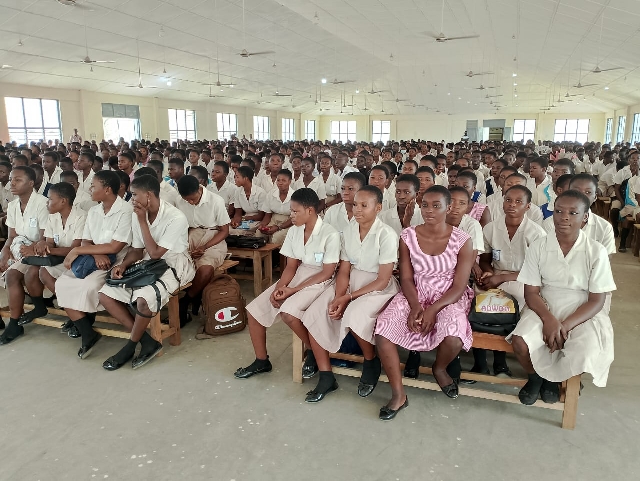 Bole SHS students
Ghana must avoid rushing education reforms to meet political timelines and instead adopt a data-driven, policy-focused strategy to eliminate the double-track system, education researcher Dr Barnabas Addai Amanfo has warned.
Reacting to the government's $300 million STAR-J initiative designed to upgrade senior high schools, Dr Amanfo stated on the Asaase Breakfast Show on Friday, May 15, that the announcement lacks weight without concrete implementation plans.
“For me, it remains an announcement,” he said.
“I am not interested in announcements. I am interested in the hard-core effects — what has been done.”
While the government aims to phase out the double-track system by 2027, Dr Amanfo questioned the feasibility of the timeline given the country's history of procurement delays and project execution obstacles.
With roughly one to one-and-a-half years remaining, he argued that the timeline is too ambitious and stressed that reforms should be guided by detailed needs assessments regarding infrastructure deficits, enrolment pressures, and regional disparities.
“We must approach this as educational policy, not a political promise,” he added.
Dr. Amanfo identified infrastructure shortages — such as overcrowded classrooms, inadequate dormitories, and poor facilities — as the most critical challenges undermining secondary education.
He also criticised the lack of standardisation in school classification, questioning the criteria used to rank institutions into Categories A, B, and C, noting that some Category C schools outperform certain Category A schools.
Regarding teacher readiness, Dr Amanfo stated that limited resources and training leave educators poorly equipped for modern, technology-driven instruction. While he welcomed proposals to train teachers in digital skills and artificial intelligence, he cautioned against superficial execution.
“It should not be that we set aside two days for training and that is all. We must see real impact,” he said.
Dr Amanfo concluded that the ultimate success of the STAR-J programme should be measured by tangible improvements in infrastructure, teaching quality, and learning outcomes, rather than simply eliminating the double-track system on paper.
Source: classfmonline.com


Trending News

Mahama announces onshore drilling in Voltaian basin and expansion of Sentuo Refinery capacity
20:32
Israel ready to support Ghana’s economic growth through technology, education, agriculture – Ambassador Roey Gilad
12:26
Black Stars battle England for World Cup knockout spot today
08:15
One dead, 31 injured in crash near Offinso SDA Hospital
21:15
Ghana’s silent health crisis takes centre stage at CHAG Conference as GMTF seeks stronger partnership
19:36
Ghana partners with Noor Dubai Foundation to eliminate river blindness by 2030
05:46
Adwoa Safo shooting: Police arrest Israel Kwadwo Safo Akofena, 2 others
00:57
C/R: 2 sisters die after house collapse following heavy rainfall in Cape Coast
21:12
A/R: Police arrest multiple suspected drug peddlers and seize large quantities of narcotics in Kumasi
19:21
V/R: Road infrastructure boosted under government 'Big Push' initiative as accident concerns mount
03:04