
Global oil shortage could hit within days as Strait of Hormuz disruption cuts supply — Expert
Business
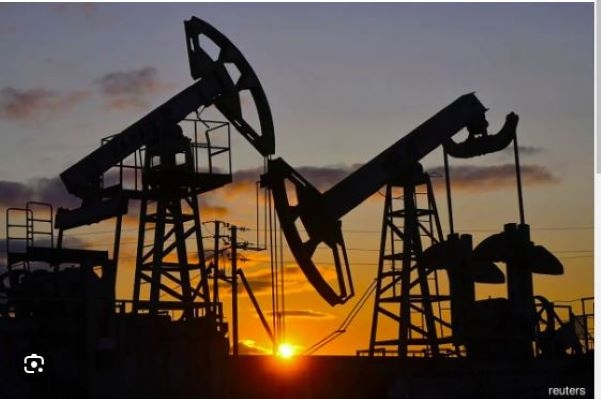 An oil rig
A leading oil and gas expert, Eric Nuttall, has warned that the world is nearing a severe energy shortage that is not yet reflected in market prices.
He estimates a global supply shortfall of about six million barrels per day following the closure of the Strait of Hormuz amid the conflict involving the US, Israel and Iran.
The disruption has trapped roughly 20% of global oil supply, forcing major producers such as Saudi Arabia to cut production by about 11 million barrels per day.
Emergency reserves have temporarily cushioned the shock but are rapidly depleting.
Nuttall described the situation as the largest supply outage in history, warning that shortages could begin within days and will push prices higher to restore market balance.
He told Joy News that even if the conflict ends and the Strait reopens, supply constraints will persist due to logistical delays, with tanker cycles taking about 60 days. This is expected to draw global storage levels down to near zero.
Efforts by Saudi Aramco to reroute supply cover only about four million barrels per day of what he estimates to be a 22 million barrel per day disruption.
Nuttall said higher prices will be necessary to curb demand, noting that oil prices rose to $109.13 per barrel for Brent crude and $112.31 for U.S. West Texas Intermediate. He warned that the global economy could come under strain if prices reach around $177 per barrel, when about 5.5% of global GDP is spent on oil.
The senior portfolio manager at Ninepoint Partners added that markets may overshoot, as seen during the COVID-19 period, and advised investors to focus on long-term trends rather than short-term volatility. He expects a sustained price environment supported by low inventories and a $10–$20 political risk premium, with $80 oil next year seen as reasonable.
The disruption is also increasing the value of secure supply sources, with Nuttall indicating that countries like Canadacould benefit due to stable production and export capacity.
Source: classfmonline.com


Trending Business

NPA to enforce stricter registration rules for petroleum tankers
02:29
NPA to enforce stricter registration rules for petroleum tankers to boost road safety
02:50
Global oil shortage could hit within days as Strait of Hormuz disruption cuts supply — Expert
01:46
Cedi records mixed performance amid demand pressures, maintains 4.51% YTD gain
01:27
Tender Committee recommends E&P for Damang Mine lease transfer
19:31
iWatch Africa’s Philip Kwasi Banini to speak at the 13th DRIF, in Abidjan, Côte d’Ivoire.
16:54
GRA reports 20% revenue surge despite E-Levy, COVID-19 and Betting Tax cuts
16:28
NEIP launches cashew project to drive local industrialisation in Ahafo Region
12:29
VIP Jeoun Transport announces nationwide fare increase effective April 8
11:01
Ghana ready for increased foreign investment – GIPC CEO
06:39