

Ghana Maritime Authority pushes local solution to costly water mapping challenge
General News
 Stakeholders at GMA meeting
The Ghana Maritime Authority (GMA) has announced plans to develop local capacity to map Ghana’s largely uncharted maritime and inland waters, citing the high cost of relying on foreign contractors.
Speaking in an interview, the Director-General of the Authority, Kamal-Deen Ali, revealed that international estimates place the cost of fully surveying Ghana’s maritime space at between €70 billion and €80 billion.
In contrast, earlier assessments by Danish partners estimated about $40 million to map inland waters.
Currently, vessels operating on inland waters are restricted to a few designated channels due to limited hydrographic data. Dr. Ali noted that these routes may not be optimal, highlighting the urgent need for comprehensive mapping.
He explained that the lack of reliable hydrographic information extends beyond navigation challenges, affecting Ghana’s bargaining power in sectors such as oil exploration and mineral licensing.
According to him, insufficient data increases perceived risks for investors, often resulting in less favourable terms for the country during negotiations.
In response to the financial constraints, the GMA is proposing a phased, locally driven strategy.
Dr. Ali indicated that with approximately $200 million—about a fraction of the full cost—Ghana could begin building the necessary technical capacity and infrastructure to undertake the mapping gradually.
He emphasized that the country already has trained personnel who can be equipped and supported to operationalize the process over time.
The Authority is working with the Ministry of Transport and its governing board to secure initial funding but acknowledges that broader collaboration will be required.
Key stakeholders expected to support the initiative include the Ghana Ports and Harbours Authority, the Petroleum Commission, and the Ghana National Petroleum Corporation.
The GMA, which hosts the National Hydrographic Office, plans to strengthen the institution by bringing together experts from agencies such as the Fisheries Commission and the Ghana Navy to build a unified national capacity.
Dr. Ali stressed that the initiative is critical not only for economic development but also for safety and national sovereignty. He noted that while Ghana has delayed undertaking comprehensive hydrographic mapping, the country now has the opportunity to begin a sustainable, long-term solution using its existing strengths.
The GMA says it is ready to commence the process, focusing first on maritime areas before extending to inland waters as capacity grows.
Source: Classfmonline.com/Edem Afanou


Trending News

Police interdict 5 officers over viral misconduct videos
00:47
GA/R: 7 arrested in Ashaiman police operation over robbery and arms supply
18:35
Dr Zanetor Agyeman-Rawlings elected 2nd Deputy President of Pan-African Parliament
23:34
Tampuli donates motorbikes, maths sets to support GES, GHS in Gushegu; extends aid to conflict-hit communities
09:47
Buipe Traditional Council pledges support for BOSTenergies
07:07
GA/R: Shai-Osudoku DCE engages quarry operators on safety and community concerns
10:43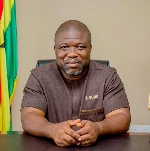
Volta Regional Minister joins workers to celebrate 2026 May Day in Ho
00:25
May Day: Central Regional Minister urges workers to reject illegal mining, deforestation
18:29
Akosombo Hydroelectric Power Station nears full capacity as fifth unit returns to service
23:08
GAFCONM cuts sod for 4-storey lecture block
03:38